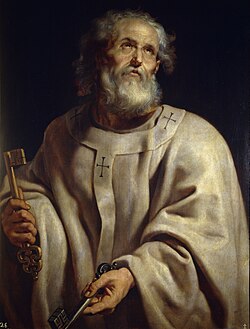
“The Apostle Saint Peter” by Peter Paul Rubens (1610-1612), Museo del Prado (Accession No. P001646), Source/Photographer Uploaded to en.wikipedia by Wlkernan (PD)
St. Peter, originally called Simon, was a native of Bethsaida, a Jewish village near the Sea of Galilee [1][2]. This would suggest that he came from humble beginnings. The Gospels, also, suggest that he had a fiery disposition.
Appropriately enough, Peter and his brother Andrew were fishermen. Instead, Christ invited them to become fishers of men (Matt. 4: 18-20).
Betrayal
Peter walked with Christ throughout the three years of His earthly ministry, hearing Him teach and witnessing countless miracles. Peter was present at the Last Supper. Yet, Peter betrayed Christ three times on the very night He was arrested (Matt. 26: 69-75; Mark 14: 66-72; John 18: 17-27).
Forgiveness
Following the Resurrection Christ forgave Peter for this betrayal (John 21: 15-17). It must though have remained on Peter’s mind.
Early church sources including Origen, Irenaeus, and Eusebius hold that Peter was crucified upside down around 64 AD [3]. It is believed that he asked to be crucified in this way, feeling unworthy to be put to death in the same manner as the Lord.
Humility
“…Clothe yourselves, all of you, with humility toward one another, for ‘God opposes the proud but gives grace to the humble’” (1 Peter 5: 5).
Peter, a recognized leader of the Apostles and considered by the Roman Catholic Church the first pope, is the patron saint of fishermen, netmakers, and ship builders. But his epistles emphasize humility [4]. His personal journey from pride to humility is a profound lesson to Christians everywhere.
The washing of the feet is a ceremony that commemorates Christ’s washing of the Apostles’ feet before the Last Supper (something Peter initially resisted) (John 13: 12-18). It is observed in various Christian denominations on Maundy Thursday during Holy Week, as a reminder to believers of the importance of humility.
Altarpiece
All of which makes it entirely fitting that an altarpiece featuring the image of a homeless man as St. Peter is now on display at the Vatican [5]. Read more…
Christ waited until the age of 30 before beginning His earthly ministry. Until then, the Creator of the world worked as a carpenter, some say a stonemason.
Why this long preparation for a ministry which lasted only 3 years?
“The reason might very well have been that He waited until the human nature He had assumed grew in age to full perfection, that He might offer the perfect sacrifice to His Heavenly Father. The farmer waits until the wheat is ripe before cutting it and subjecting it to the mill. So He would wait until His human nature had reached its most perfect proportions and its peak of loveliness before surrendering it to the hammer of the crucifiers and the sickle of those who cut down the Living Bread of Heaven. The newly born lamb is not offered in sacrifice, nor is the first blush of the rose cut to pay tribute to a friend. Each thing has its hour of perfection. Since He is the Lamb that set the hour for the sacrifice, and since He is the Rose that can choose the moment of His cutting, He will wait patiently, humbly and obediently, while He grows in age and grace and wisdom before God and man. Then He will say: ‘This is your Hour.’ Thus the choicest wheat and the reddest wine will be the worthiest elements of Sacrifice — the best this world can give for its consecration and its peace [1].”
–Archbishop Fulton J. Sheen
—
[1] The Life of Christ by Fulton J. Sheen, published by Maco Magazine Corporation, Copyright © 1954 Bishop Fulton J. Sheen.
READERS CAN FIND MY VIEWS ON ABUSE AND ABUSE-RELATED ISSUES AT A Voice Reclaimed, Surviving Child Abuse and More
https://avoicereclaimed.com

“The Prodigal Son Among the Swine” by Albrecht Durer (1494-1498), Rijksmuseum (Accession No. RP-P-OB-1185), Amsterdam, Source Rijksmuseum, (PD)
In his print “The Prodigal Son Among the Swine” the artist Albrecht Durer chose to show the headstrong son at his lowest ebb, kneeling in prayer in a pigsty. This was the beloved son of a wealthy father, who squandered his inheritance on loose living (Luke 15: 11-32).
“The one who prays in the midst of his sin already sees beyond his sins, even if he believes he can see nothing else. Dignity, which is reborn in the redeemed sinner, is here in its embryonic stage.
That’s the moment Durer chose to depict. Not the celebration of the son’s return. Not the father’s embrace. But the instant when someone broken by his own choices turns toward home. Prayer amid the wreckage. The first stirring of hope in the heart of the lost. The prodigal hasn’t cleaned himself up yet. He’s still in the pigepen. But he’s already being transformed.”
–Leonard J. DeLorenzo PhD, McGrath Institute for Church Life at Notre Dame
We are all, in a sense, among the swine; all struggling with sin, of one kind or another. Recognizing that is an essential step toward repentance.
“And he arose and came to his father. But when he was still a great way off, his father saw him and had compassion, and ran and fell on his neck and kissed him” (Luke 15: 20).
—
[1] The Dialog, 1/9/26, pp 4-5, “Viewpoints – Personal connection can be lost in an age of diminished human closeness” by Leonard J. DeLorenzo.
READERS CAN FIND MY VIEWS ON ABUSE AND ABUSE-RELATED ISSUES AT A Voice Reclaimed, Surviving Child Abuse and More
https://avoicereclaimed.com

Honor killing victim Romina Ashrafi, copyrighted image used in the Wikipedia article “Murder of Romina Ashrafi” at https://en.wikipedia.org/wiki/Murder_of_Romina_Ashrafi, Original Publication and Immediate Source https://x.com/YasamanFlower/status/1271983832862994433/photo/1 (Non-Free Use Rationale as identification of specific individual, now deceased, for whom there is no known representation under a free license)
In Europe, there is a growing acceptance of Sharia law, the legal system of Islam.
- In Austria, a Viennese court has ruled that Sharia Law is legally valid [1A].
- In Germany, Sharia law is used to rule on domestic conflicts between Muslims [1B].
- In England, dozens of Sharia Councils have existed for years. A Muslim Arbitration Tribunal there, recognized by Britain’s Arbitration Act of 1996, allows civil disputes to be resolved based on Sharia [1C].
- According to the European Court of Human Rights, criticism of Islam is not protected as free speech. The court fined a Viennese woman for injuring the religious feelings of others when she stated her opinion that the Prophet Muhammad was a pedophile for his marriage to Aisha (a marriage arranged when the girl was 6 years of age, and consummated when she was 9 years of age) [1D].
Sharia in the United States
Sharia law in the United States is subject to the US Constitution. Sharia may serve as a personal guide for Muslims, but is not legally enforceable, and does not supersede federal or state, criminal or civil law [2].
A. Federal Initiative
A Sharia-Free America Caucus has recently been formed in the US House of Representatives to prevent Sharia law from gaining a foothold here [3].
The goals of this caucus include expressly prohibiting the enforcement of Sharia law judgments; denying tax exemptions to individuals or institutions handing down Sharia law judgments; barring those who adhere to Sharia law from entry into the United States, and deporting any resident aliens who adhere to Sharia law.
B. State Initiatives
As of this writing, at least 14 states have enacted foreign law bans targeting Sharia [4].
C. Polygamy
The fact that polygamy is illegal in the United States has not kept some Muslim men here from taking multiple wives [8]. No one knows for certain how many Muslims in the United States live in polygamous families [16A]. However, estimates range from 50,000 – 100,000 [16B]. Black Muslims, in particular, are turning to polygamy [17].
D. Honor Killings
So called “honor killings”, also, occur in the United States. These primarily involve women and girls murdered for allegedly having brought shame on their families. Read more…

Books of Ahl al-Sunnah wal-Jamaah, Author Bakkouz at Arabic Wikipedia (PD)
WARNING: Graphic Images
Sharia law is the legal system of Islam based on the Quran, Hadith (oral tradition as to the actions of the Prophet Muhammad and his close circle), and Sunnah (the teachings of the Prophet Muhammad) [1A][2][3][4].
It consists of a series of duties considered God’s command to Muslims, serving as a guide for conduct in this world and divine favor in the next.
Scope
Sharia is broader than Western systems of law. It governs public behavior, private behavior, and private beliefs. Sharia law cannot be altered, but is variously interpreted by Islamic jurists (muftis). Ritual practices like daily prayers, almsgiving, fasting, and pilgrimage are integral.
Provisions
Sharia prioritizes punishment over rehabilitation, and is extremely restrictive of women. Some of its provisions are, as follows:
A. Forced Conversion
Sharia law instructs Muslims to fight unbelievers until they are either dead, converted to Islam, or in a permanent state of subjugation [14A].
Suras 9 and 5 of the Quran are the last major chapters the Prophet Muhammad narrated, therefore, overrule what came before, including the often quoted verse “There is no compulsion in religion…” (Quran 2:256) [14B].
“Say to those who have disbelieved, if they cease [from disbelief] their past will be forgiven… And fight them until there is no more Fitnah [disbelief and polytheism, i.e. worship of others besides Allah] and the religion [worship] will all be for Allah Alone [in the whole of the world]”(Quran 8:38-39)[14C].
“Fight those who believe not in Allah nor the Last Day, nor hold that forbidden which hath been forbidden by Allah and His Messenger, nor acknowledge the religion of Truth, [even if they are] of the People of the Book, until they pay the Jizya with willing submission, and feel themselves subdued”(Quran 9:29)[14D].
“…kill the infidels wherever you find them and capture them and besiege them and sit in wait for them at every place of ambush. But if they should repent, establish prayer, and pay tribute tax, let them [go] on their way” (Quran 9:5)[5B][14E].
B. Death Penalty
- Criticizing or denying Allah is punishable by death (Quran 6:39)[1B][8A].
- Criticizing the Prophet Muhammad or denying that he is a prophet is punishable by death (Quran 33:57 and 33:61; Sahih Bukhari 59:369, 3:106, and 4:241; Sahih Muslim 1801)[1C][8B].
- Criticizing or denying any part of the Quran is punishable by death [1D][27A].
- Apostacy is punishable by death [1E][16A][27B].
- A non-Muslim who leads a Muslim away from Islam is to be put to death [1F].
- A non-Muslim man who marries a Muslim woman is to be put to death [1G].
- A woman or girl found guilty of adultery is to be put to death [1H][16B].
- A woman or girl who alleges rape without producing 4 male witnesses is guilty of adultery, and is to be put to death [1I].
- Homosexuality is punishable by death, but the sodomy of boys has been culturally acceptable (Quran 52:24)[1J][6A][15][18][19][23][24][25][26][29].
C. Amputation
- Theft by one Muslim from another is punishable by amputation of the hands (Quran 5:38) [1K]. Pillaging of non-Muslims is permissible (Quran 8:69, 48:20) [12]. Property rights for non-Muslims exist only at the discretion of Muslim rulers.
Other punishments include flogging and stoning [16C].
D. FGM (Clitorectomy) and Rape
- Some form of Female Genital Mutilation (FGM), up to and including clitorectomy, is either recommended or required by all classical Sunni schools of Islamic jurisprudence, generally approved by Shi’i jurists, and obligatory in the Shafi’i school (Book 41, Kitab Al-Adab, Hadith 5251) [1L][6C][20][28]. The term “female circumcision” fails to acknowledge the severe health risks, and human rights violations involved [32][33].
- Muslim men have sexual rights to any woman/girl not wearing a Hijab [1M]. Taharrush Gamea is the coordinated seхual assault of a girl or a woman in public by a mass of Muslim men [7]. This was illustrated by the mass sexual assaults against female protesters in Tahrir Square, Cairo, Egypt in January 2011, November 2012, January 2013, and June 2013 [30][31].
- A woman or girl who has been raped cannot testify in court against her rapist(s) [1N].
- Testimonies of 4 male witnesses are required to prove rape of a female (Quran 24:13) [1O].
- A male convicted of rape can have his conviction dismissed by marrying his victim [1P].

Exhibition of computer and video games, Source Igromir 2016, Author Sergey Galyonkin of Raleigh, NC (CC BY-SA 2.0 Generic)
Samsung, at the 2026 Consumer Electronics Show in Las Vegas earlier this year, emphasized that its “bespoke AI experiences” are intended to simplify decisions, and make life more convenient and enjoyable [1A][2A][3].
Artificial Companions
Toward that end, an AI companion called “Ami” (essentially a surveillance device) is now being marketed by the Chinese company Lepro as a “soulmate” to combat loneliness [1B]. Project AVA by Razer, a desktop hologram, is another such companion [2B].
Meanwhile, a mechanical pet with an endearing face called Sweekar by Takway AI is described as having emotional intelligence, and said to evolve alongside its owner [4].
Artificial Environments
Cozy gaming is an exploding trend. These are video games that offer soft color graphics, a heartwarming story, a flexible pace without time limits, and no real difficulties or stress [5]. Wylde Flowers and Cozy Space Survivors are two illustrations. Some horror games even come with cozy modes.
A Digital Cocoon
The New Yorker characterized the trend toward AI companions and cozy gaming as an attempt to “swathe ourselves in a digital and physical cocoon [6].” This is not far wrong. The world feels harsh. We are seeking relief through technology. Read more…

Mardi Gras, New Orleans, Source Infrogmation, Author Infrogation of New Orleans (CC BY-SA 4.0 International, 3.0 Unported, 2.5 Generic, 2.0 Generic, 1.0 Generic and GNU Free Documentation License)
Mardi Gras is on February 17th this year. As always, it falls on the last day before Ash Wednesday, the beginning of Lent.
Mardi Gras is French for “Fat Tuesday”, referring to the last day Christians have traditionally been permitted to indulge in rich foods before the Lenten fast [1]. In New Orleans, it stretches from Twelfth Night a/k/a Epiphany on January 6th to Ash Wednesday. Mardi Gras represents a last opportunity for merrymaking.
Few revelers these days plan to adhere to religious obligations in the weeks afterward. Most Christian denominations still do though observe the penitential Lenten season [2].
In contrast with Mardi Gras, the 40 days of Lent are meant to remind us of Christ’s fast in the desert before His public ministry, and turn our thoughts to His Passion. For Christians, it is a time of introspection and repentance. Many churches remove flowers from their altars, and veil the crucifix during Lent.
Lent, of course, culminates in Easter – that most joyous of celebrations commemorating Christ’s Resurrection. No amount of Mardi Gras revelry can compare.
—
[1] Wikipedia, “Mardi Gras”, https://en.wikipedia.org/wiki/Mardi_Gras.
[2] Wikipedia, “Lent”, https://en.wikipedia.org/wiki/Lent.
READERS CAN FIND MY VIEWS ON ABUSE AND ABUSE-RELATED ISSUES AT A Voice Reclaimed, Surviving Child Abuse and More
https://avoicereclaimed.com
The posts in this series are excerpted from an article titled “God on Trial: Applying Modern Legal Standards to Assess Arguments For and Against the Existence of God” by Michael Conklin in the Journal of Christian Legal Thought, Vol. 15, No. 2, 2025.
“Arguments Against the Existence of God
Existence of Evil/Suffering
…This argument generally takes the following form: an omniscient, omnipotent God would not want any evil or suffering on Earth and would have the power to remove evil and suffering; therefore, the presence of evil and suffering proves that there is no God…
The argument fails because the two assumptions required by the premises – that God necessarily desires to eradicate all pain and suffering on Earth and that omniscience, omnipotence, and omnipresence would make such an act possible – are both false…
[W]hile it is true that God could create a world without any evil or suffering, accomplishing this would require stripping every creature of free will. ..
This argument also fails because there is a plethora of valid reasons why a God would permit evil and suffering. The ability of our central nervous system to transmit the feeling of pain serves a valuable function that helps keep us alive, such as when we experience excruciating cold temperatures and seek out warmth…Futhermore, if there were no pain and suffering, there would be no opportunity for humans to be compassionate to others and no opportunity to experience the compassion of others…
The Problem of Divine Hiddenness
…[This] argument presumes that there is some level of overwhelming proof that would compel everyone to believe in God. But as even some atheists have admitted, regardless of how salient God were to make Himself, they would nevertheless refuse to believe…
…One Less God Than Monotheists
One argument that is repeatedly made by atheists is how, in comparison to a monotheist, the atheists believe in one less God…The reason this is a complete non sequitur is that it merely states the definitional difference between a monotheist and an atheist; it has no significance as to whether God does or does not exist…
Negative Effects of Belief in God
Some atheists have attempted to make a case against the existence of God by claiming that belief in God is harmful to humans…[This] would be excluded [in a court of law]…as lacking relevance and likely…for being unfairly prejudicial. The same would be true if the theist attempted to argue that God does exist because of the benefits that come from believing in God. In both instances, the truth value of the proposition – that God either does or does not exist – is completely independent of its social consequences.
Argument from Scale
Some atheists have attempted to point to the vastness of the universe as evidence against the existence of God…There are numerous potential explanations for why God might want to create a large universe, and no reason to believe that God would be obligated to create a smaller universe…
Future Evidence…
Many atheists seem to be relying heavily on an optimistic hope that some future discovery will serve as evidence for atheism…But…merely pointing to the possibility of such future evidence does nothing to support atheism….[T]he theist would be equally justified in positing that, if such evidence for atheism were to be found, some later evidence might then be found refuting the atheist’s future evidence…
Conclusion
As demonstrated throughout this Article, when courtroom standards are applied to this question in an intellectually honest manner, the only logical conclusion is that it is more likely than not that God exists…This conclusion is relevant to nearly every aspect of our lives, as it helps answer profound questions about our origin, moral obligations, and ultimate purpose.”
Parts 1 and 2 in this series were posted 1/18/26 and 1/25/26, respectively
READERS CAN FIND MY VIEWS ON ABUSE AND ABUSE-RELATED ISSUES AT A Voice Reclaimed, Surviving Child Abuse and More
https://avoicereclaimed.com

Gavel, Author Quince Media (CC BY-SA 4.0 International)
The posts in this series are excerpted from an article titled “God on Trial: Applying Modern Legal Standards to Assess Arguments For and Against the Existence of God” by Michael Conklin in the Journal of Christian Legal Thought, Vol. 15, No. 2, 2025.
“Arguments for the Existence of God
Cosmological Argument
…[E]verything that begins to exist has a cause for its existence…[B]ecause the universe contains all space and time, its cause must transcend space and time, thus being timeless, non-physical, and non-material…
[P]ositing that the universe is more likely to be eternal than finite is not a feasible objection…[T]he overwhelming scientific and philosophical evidence strongly rejects this…For example, Einstein’s general theory of relativity is only consistent with a finite universe…
…[S]ome atheists try to avoid the implications of the cosmological argument by simply declaring that the universe needs no explanation…Perhaps this is most analogous to a defendant in a civil case stating, ‘In response to all the evidence presented…I just didn’t do it, and that’s all.’
…[A] similar example…is when atheists claim that the universe somehow caused itself to exist…This would be the intellectual equivalent of a defendant trying to explain the existence of illegal contraband in his possession by positing that it must have caused itself to come into existence…
Moral Argument
…God is necessary for objective morality to exist…[M]ost people will acknowledge that objective morality exists…
While it is true that the moral argument completely fails if objective morality does not exist, this is not an attractive option for the atheist. By claiming that objective morality does not exist, this puts pressing issues such as racism and sexual assault on par with mere faux pas such as wearing white after Labor Day…A moral relativist could make claims such as, ‘I personally would not commit sexual assault’…But they would be unable to state that there is anything morally wrong with one who perpetrates sexual assault…
Some atheists…claim that objective morality can exist apart from God in that whatever helps human flourishing is moral…But such a standard is patently arbitrary, why not instead base morality on whatever helps the flourishing of…dolphins, or pear trees?
…Some atheists attempt to argue against the existence of objective morality by pointing to how different people maintain different opinions regarding morality. While true, this does nothing to refute the moral argument. Objective truth does not necessitate unanimity of agreement. For example, the Earth is objectively spherical even though some people still believe it to be flat…”
This series will conclude next week
READERS CAN FIND MY VIEWS ON ABUSE AND ABUSE-RELATED ISSUES AT A Voice Reclaimed, Surviving Child Abuse and More
https://avoicereclaimed.com

Old gavel and court minutes, Author Jonathunder (CC BY-SA 4.0 International, 3.0 Unported, 2.5 Generic, 2.0 Generic, 1.0 Generic and GNU Free Documentation License)
The posts in this series are excerpted from an article titled “God on Trial: Applying Modern Legal Standards to Assess Arguments For and Against the Existence of God” by Michael Conklin in the Journal of Christian Legal Thought, Vol. 15, No. 2, 2025.
“…This Article applies cross-examination, the rules of evidence, and the rules of civil procedure to the question of whether God exists…
Proper Burden of Proof
…In the US criminal justice system, the prosecutor is required to prove guilt ‘beyond a reasonable doubt’…This imposes a high burden…Many atheists attempt to likewise apply a disproportionate burden of proof on the theist, therefore allowing the atheist to simply sit back and say ‘not good enough’ to all the evidence presented for God’s existence…
The reason the burden of proof is so high in criminal cases is that society has established that we should err on the side of acquittal rather than conviction given the deprivation of liberty, and sometimes even life, that are at stake…But these considerations…are not present in the debate of God’s existence…
One method employed by atheists in an effort to impose an unjustifiably high burden of proof on the theist is to claim that ‘extraordinary claims require extraordinary evidence.’ This is followed by the assertion that the existence of God is an extraordinary claim…Throughout history and still to this day, [however,] belief in God is the norm…
Another misguided attempt by the atheist to stack the debate…is to claim that atheism is the default position and, therefore, it is the theist who bears the burden of proof…[O]ne of the most common [ways] is to allege that, because one cannot prove a negative, the burden lies with the theist to prove God’s existence, and an inability to perform this task to the atheist’s satisfaction results in the atheist prevailing…
[But i]n court proceedings, parties routinely present evidence in an effort to prove a negative. A criminal defendant may present credit card statements, video surveillance footage, and eyewitness testimony to prove that he was not within 300 miles of where the murder occurred…
Some atheists attempt to circumvent the burden of proof altogether by…claiming that atheism does not posit that God does not exist; rather, atheism is merely a lack of belief in God. This is then used as a tactic to claim…that no evidence is required of them. This is a highly peculiar framing of atheism by the very atheists who write books and engage in passionate debate promoting the idea that God does not exist…
Relevance
…The Federal Rules of Evidence require the evidence must be ‘relevant’ to be admissible…A piece of evidence meets the relevant standard if it merely ‘has a tendency to make a fact more or less probable’…
It is interesting to note that the very existence of a legal system implies the existence of God. Under atheism, our minds are merely a random assortment of atoms, and our actions merely the products of random chemical interactions. Under such a worldview, there would be no more basis for imposing liability on humans than there would be for imposing liability on some molecules in the atmosphere that caused a chemical reaction harming some other molecules…”
This series continues next week
READERS CAN FIND MY VIEWS ON ABUSE AND ABUSE-RELATED ISSUES AT A Voice Reclaimed, Surviving Child Abuse and More
https://avoicereclaimed.com

 A Lawyer's Prayers